
We’ve all experienced that moment: the mower is put away, the lawn looks tidy, and then you notice those rebellious tufts along the wall or around the flowerbed. The string trimmer solves this problem in just a few minutes, provided you’ve chosen the right model. The trap is to rely solely on the motorization without considering the actual configuration of your terrain, the distance to be covered, or the type of edges to maintain.
Physical Edges and String Trimmers: Why One Doesn’t Replace the Other
Even before discussing tools, you can drastically reduce the time spent on the string trimmer by structuring the garden’s contours. Flexible technical borders made from recycled PEHD, like Ecolat borders, withstand UV rays, frost, and moisture without flinching. They can be installed without specialized tools and can be shaped into curves with slight heating.
The result: clean lines that limit chaotic regrowth between the lawn and flowerbeds. You use the string trimmer less often, and most importantly, you no longer have to correct lawn edges that deform each season.
However, no physical border eliminates the need for a string trimmer. Grass grows over the top, stolons overflow, and finishing touches at the base of trees or along a fence remain inaccessible to any passive device. We regularly compare the available models on taille-bordure-warrior.com to adjust the choice of tool to the reality of the terrain.
Cutting Line and Spool Head: The Detail That Changes Everything on the Ground
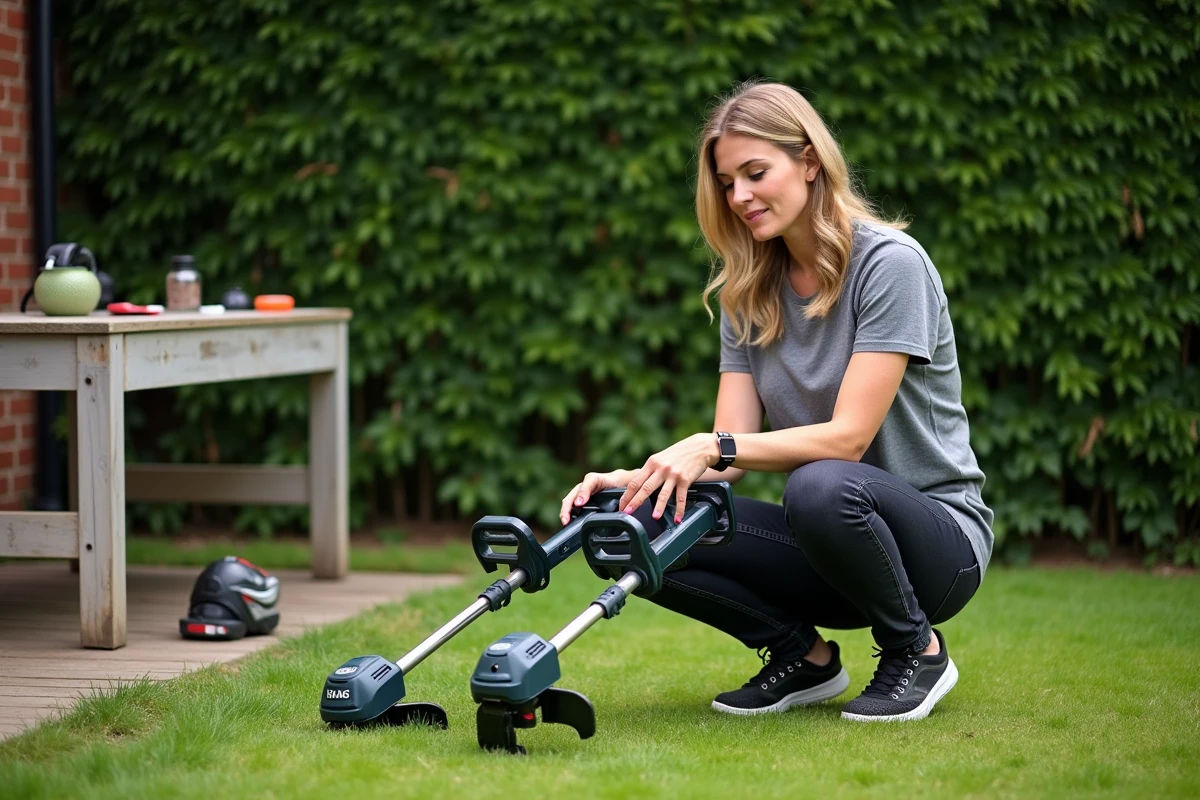
The motorization grabs all the attention, but it’s the line that does the work. A line that’s too thin breaks on tough grasses or woody grasses at the edge of the flowerbed. A line that’s too thick strains a low-powered motor and results in uneven cuts.
Choosing the Right Line Profile According to Vegetation
- The classic round line is suitable for soft grass around paths and in flat terrain, where the focus is mainly on finishing after mowing the lawn.
- The square or serrated line better tackles thick grasses, weeds at the edge of hedges, and areas that are somewhat neglected during winter. It is preferred whenever the terrain has semi-wild parts.
- The helical (twisted) line reduces noise and projects fewer debris, a real comfort gain during long sessions or in a city garden close to neighbors.
The semi-automatic spool head remains the best compromise for most gardens. You tap the head on the ground, and the line releases, no need to disassemble. Manual heads require stopping the motor and re-threading the line by hand, which doubles the intervention time on slightly longer terrain.
Battery, Electric or Gas: The Real Criterion is Distance
Competitors often classify string trimmers by type of motorization, as if it were a simple preference. In practice, it’s the distance between the power outlet and the farthest cutting area that decides.
When the Battery is Essential
As soon as you exceed about thirty meters of extension cord, the electric line becomes an obstacle. It gets caught on table legs, stakes, and rose bushes. Battery models from brands like Husqvarna or Stihl offer sufficient autonomy to handle a medium-sized garden in a single charge.
Feedback varies on the actual duration of autonomy depending on vegetation density, but it is noted that a good capacity battery easily lasts for a complete finishing session if not used continuously on very resistant grasses.
The Gas for Rough Terrain
A sloped terrain, borders far from any dwelling, brambles at the edge: the gas string trimmer retains the advantage of raw power and unlimited autonomy (as long as you have fuel). On difficult terrain, the gas remains the most reliable machine for long interventions. In return, it is heavier and requires regular engine maintenance.
Mowing Height and Frequency: Adapting the String Trimmer to the Season
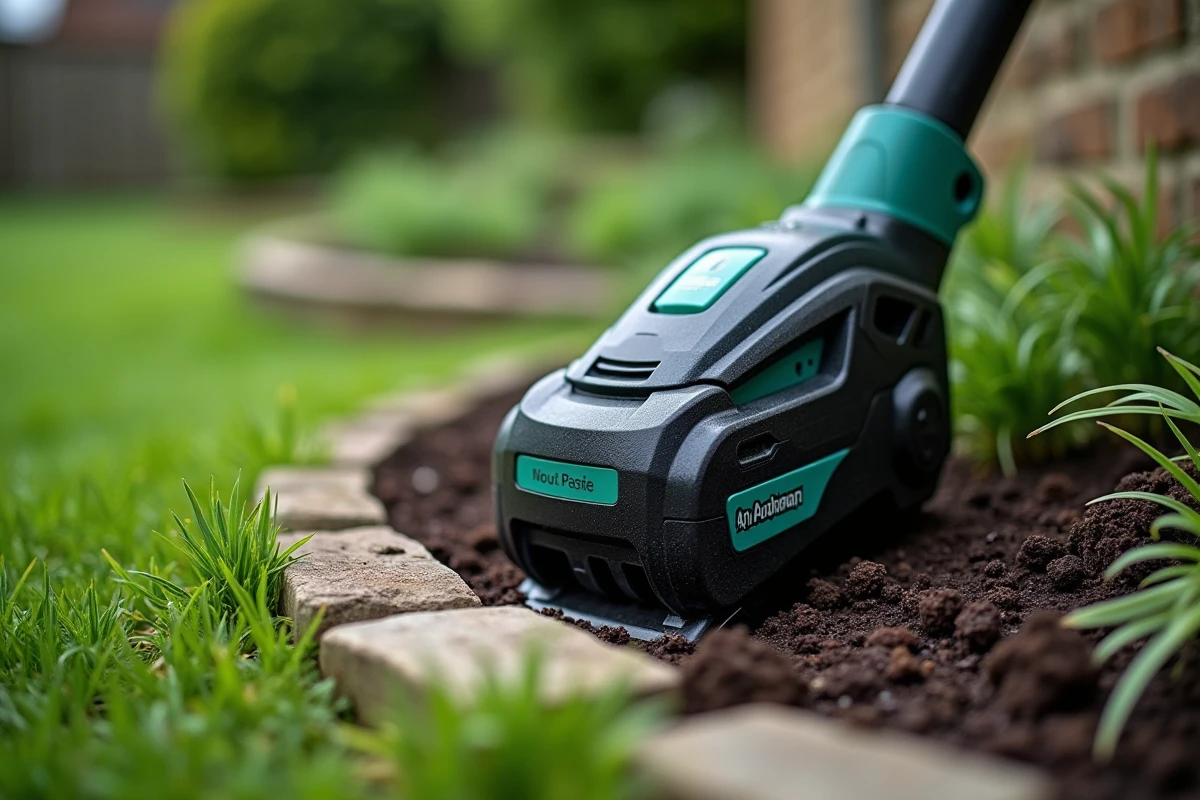
You don’t use the string trimmer the same way in April and August. The cutting height of the grass directly influences regrowth along the edges. Manufacturers like Navimow recommend mowing higher in summer (between 6 and 8 cm) and never removing more than a third of the blade height.
Mowing high limits grass stress, yellowing, and chaotic regrowth along the edges. The result: you space out the string trimmer sessions in the heart of summer while keeping a clean appearance.
In early spring, when growth restarts strongly, you intervene every week or every two weeks. In summer, a session every three weeks is sufficient if mowing is well calibrated. This seasonal logic prevents premature wear of the line and battery.
Robotic Mower with Side Cutting: An Alternative to Watch
Some models of robotic mowers, particularly from Husqvarna, incorporate a side cutting mode that significantly reduces the strip of residual grass along walls and borders. The robot does not eliminate the string trimmer, but it reduces its use to a few touch-ups.
This type of solution is suitable for relatively flat gardens with well-defined borders. On uneven terrain or with many corners, the robot misses areas that only a manual string trimmer can reach.
The choice of a string trimmer depends less on the brand than on three concrete parameters: the distance to cover, the type of vegetation at the edge, and the mowing frequency of the lawn. Addressing these three points before purchase prevents ending up with an undersized tool that ends up left at the back of the garage.