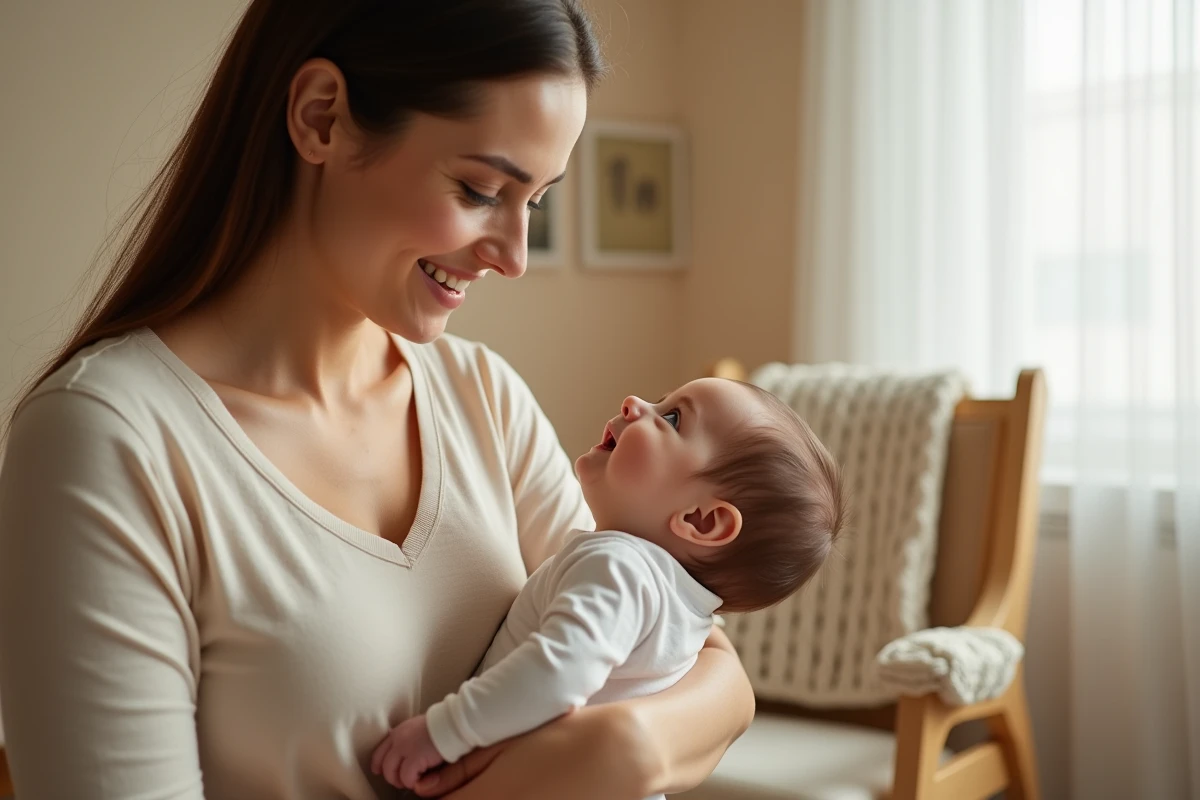
A three-week-old baby who calms down as soon as placed on their mother’s chest, a one-month-old infant who turns their head toward a familiar voice: maternal recognition does not begin on a specific date. It builds layer by layer, sensory channel by sensory channel, long before the baby’s gaze truly focuses on a face.
Olfactory and auditory recognition: what the newborn perceives from birth
In the delivery room, we regularly observe a crawling behavior: the newborn placed on their mother’s belly instinctively crawls toward the breast. This reflex is based on smell. Amniotic fluid and colostrum share olfactory markers that the baby has integrated during pregnancy.
The maternal voice operates on the same principle. After several months of exposure in utero, the newborn distinguishes this voice from other sounds in their environment. It is easy to spot: the baby turns their head toward their mother’s voice and slows their movements, a sign of selective attention.
These two channels (smell and hearing) form the foundation of early recognition. They function even when vision remains blurry, which is the case for several weeks. To delve deeper into these sensory mechanisms, you can find advice on Your Health Assistant that details each step of this progressive recognition.
Infant vision: when mom’s face becomes recognizable
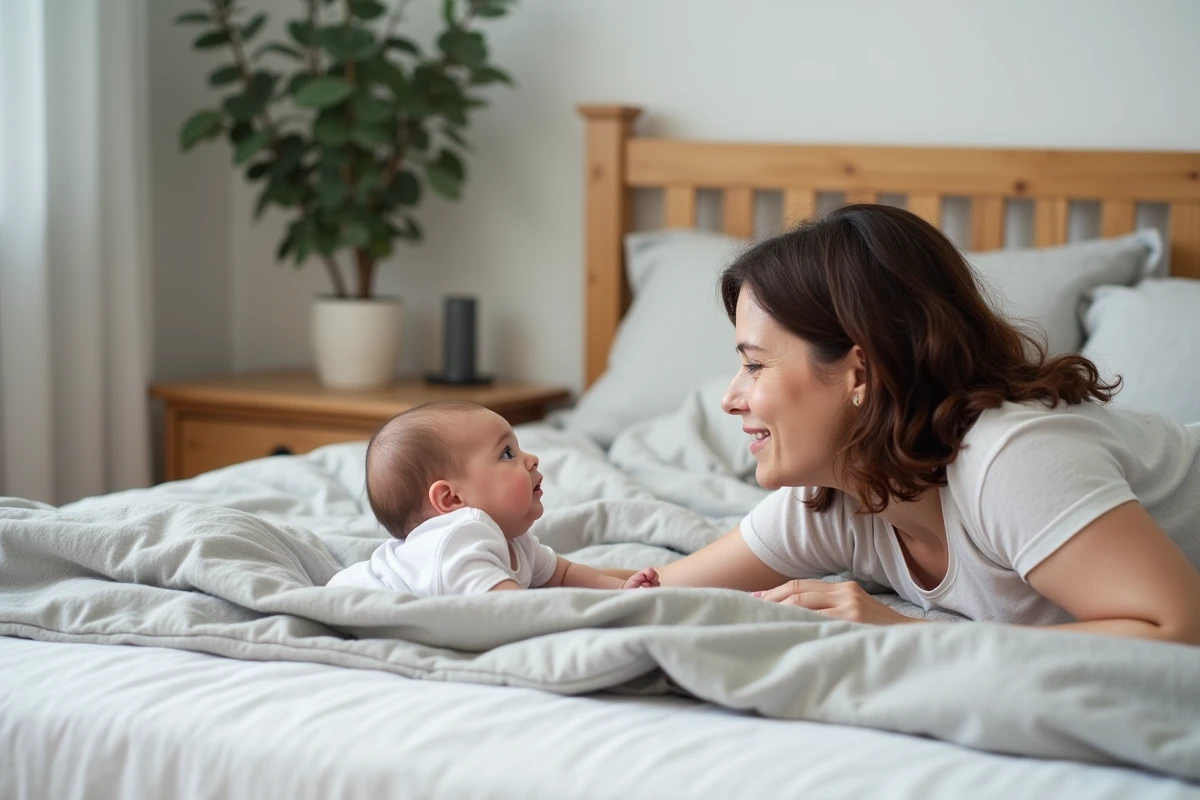
The newborn can see, but in a very limited way. Their area of sharpness is about twenty centimeters, which is the distance from the crook of the arm to the face of the parent holding them. Strong contrasts (the outline of the face, hairline) attract their gaze before fine details.
The first weeks: attraction without discrimination
During the first weeks, the baby looks at faces without really differentiating them. They react to the general shape (two eyes, a nose, a mouth) rather than the specific identity of the person. It is an attraction to the “human face” pattern, not yet an individual recognition.
The milestone of two to three months
Stable visual recognition gradually establishes itself between two and three months. The baby then begins to compare familiar faces to new ones. This is evident in differentiated reactions: a more pronounced social smile toward the mother or father, prolonged gaze, joyful agitation.
This period also corresponds to a rapid maturation of the retina and visual cortex. The infant perceives colors, expressions, and depth better. Reports vary on the exact moment this click occurs, as each baby has their own neurological maturation rhythm.
Concrete signs that the baby recognizes their mother daily
We often look for a “test” to verify recognition. In practice, it is everyday behaviors that serve as reliable indicators:
- Calmness upon contact: a crying baby calms down faster in the arms of their attachment figure than in those of a stranger. This is not politeness; it is a reflex related to emotional security.
- Head orientation: placed in their crib, the infant spontaneously turns their head toward the maternal voice or smell, even without direct visual contact.
- Selective social smiling: around two months, smiling is no longer just a reflex. The baby smiles more at faces they regularly encounter, first at their mother or the primary caregiver.
- Protest at separation: between six and eight months, the baby clearly shows their disagreement when their attachment figure moves away. This behavior, sometimes challenging for parents, confirms that the recognition bond is firmly established.
Attachment figure and recognition: it is not always the biological mother
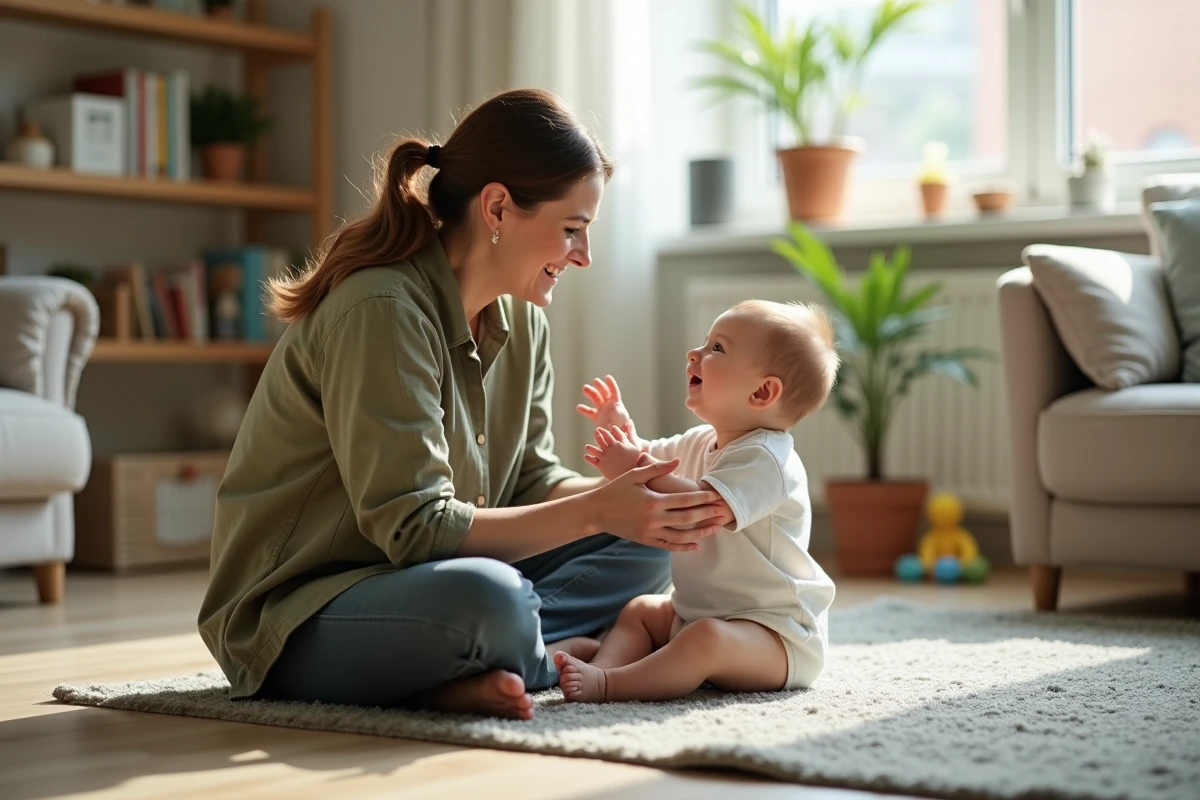
Dr. Anne Raynaud, psychiatrist and founder of the Institute of Parenting, emphasizes a fundamental point: the baby attaches to the person who cares for them daily. In attachment theory, we refer to the “primary attachment figure,” and this role is not reserved for the biological mother.
A very present father, an adoptive parent, or a childcare assistant who provides regular care can become this figure. What matters is the consistency, predictability, and quality of presence. The baby builds their recognition on the repetition of interactions (feeding, rocking, talking, looking), not on a genetic link.
Dads in the equation
The father’s recognition follows a similar pattern but is delayed by a few weeks if the father is less present during the very first days. Early skin-to-skin contact with the father accelerates this recognition. Smell and voice play the same role as with the mother: the more frequent and prolonged the contact, the more quickly the baby identifies this second figure.
Strengthening the recognition bond daily
No special equipment or specific method is needed. The most mundane gestures are also the most effective for consolidating recognition:
- Maintain eye contact during feeding and diaper changes, at close range (about twenty centimeters for the first weeks).
- Talk to the baby in your natural voice, not a distorted voice. Consistency in tone helps the infant associate the voice with the person.
- Prioritize regular skin-to-skin contact, especially in the first weeks, to strengthen the olfactory channel.
- Respond to cries predictably: a baby who receives a consistent response to their signals develops a more secure attachment, which reinforces recognition.
Maternal recognition has no deadline. A premature baby, an adopted baby, or a baby separated from their mother for medical reasons eventually builds this bond as soon as the conditions for proximity are met. What makes the difference is not the timeline, but the consistency of care and the quality of shared moments.