
The commonly accepted range of 60 to 100 beats per minute at rest still applies at age 70, but it masks the most useful information: pulse regularity matters just as much as heart rate. A perfectly regular rhythm at 72 bpm and a rhythm at 72 bpm interrupted by pauses or brief bursts of acceleration do not have the same clinical significance at all.
Irregular pulse at 70: what heart rate alone doesn’t reveal
A resting heart rate between 60 and 80 bpm is generally considered satisfactory for a 70-year-old adult. People who exercise regularly may have a heart rate below 60 bpm without any problem, provided this bradycardia is stable and causes no symptoms.
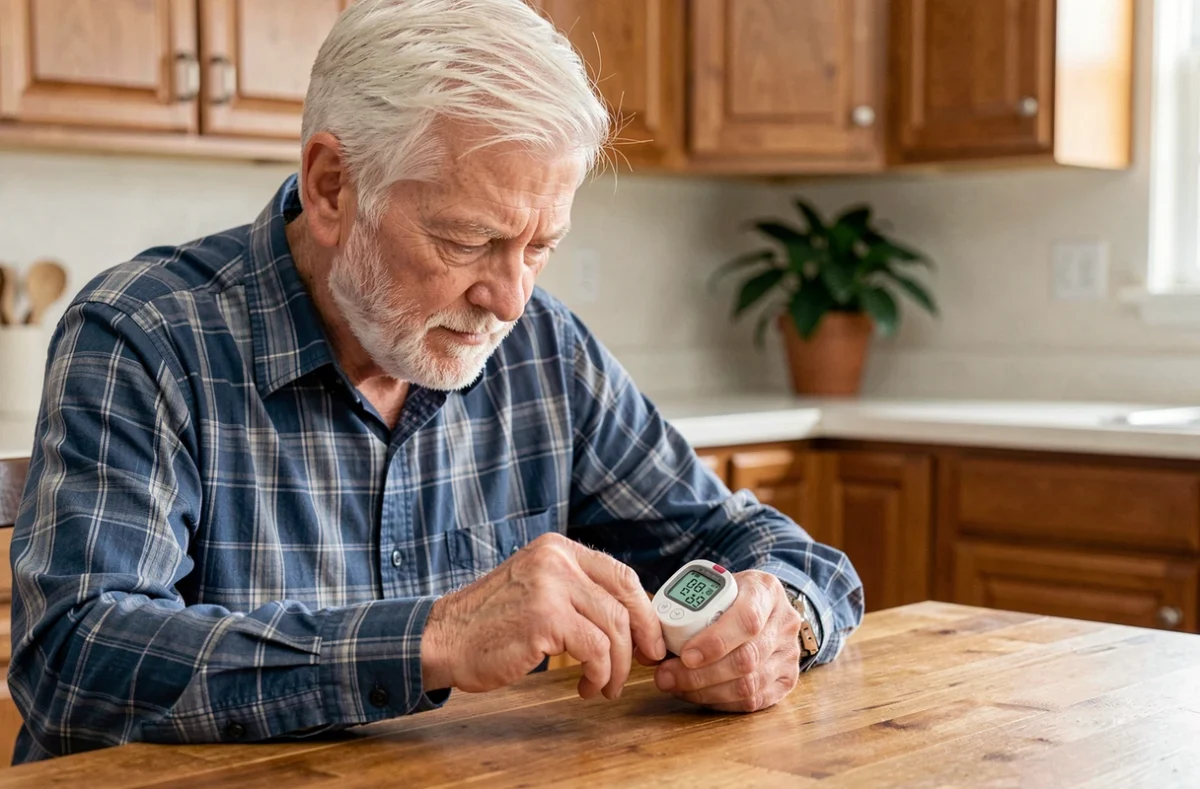
The pitfall is relying solely on the number displayed on a blood pressure monitor or smartwatch. These devices measure average heart rate, not regularity. Atrial fibrillation can remain asymptomatic for months in a 70-year-old whose average pulse appears normal. Only an ECG can confirm it, according to the NHS NG196 guidelines.
In practice, manually checking the radial pulse for 30 seconds is still a useful screening measure. We recommend noting not only the number of beats, but also the intervals between them: a pulse that “skips” or alternates between closely spaced beats and longer pauses warrants a medical consultation, even if a normal heart rate for a 70-year-old woman falls within the expected range.
Resting heart rate after 70: interpreting changes
Resting heart rate is not a fixed number. It fluctuates depending on the time of day, digestion, ambient temperature, medications (beta blockers, calcium channel blockers) and stress levels. In older adults, heart rate variability tends to decrease with age, making sudden changes all the more significant.
Tachycardia and bradycardia: warning thresholds
Above 100 bpm at rest without prior exertion is considered tachycardia. Fever, dehydration or acute stress may explain it, but persistent tachycardia at age 70 requires a cardiac assessment.
Below 50 bpm, bradycardia becomes a concern if accompanied by unusual fatigue, dizziness or faintness. A lifelong endurance athlete may function at 48 bpm without discomfort. A sedentary person with the same heart rate should seek medical advice.
Symptoms that change the level of urgency
A fast or irregular heartbeat accompanied by any of the following signs requires urgent medical attention:
- Chest pain, even if moderate, felt as pressure or tightness
- Significant shortness of breath at rest or during minimal exertion (climbing a few steps)
- Neurological symptoms: weakness on one side of the body, difficulty speaking or seeing, sudden confusion
- Fainting with loss of consciousness, even briefly
Without these warning signs, a slightly elevated pulse after a large meal or a restless night is not an emergency, but it is worth mentioning to your doctor at your next appointment.
Smartwatches and pulse monitoring: how reliable are they for seniors?
Optical sensors in smartwatches and fitness bands measure blood flow at the wrist using photoplethysmography. This technology is generally reliable for measuring average heart rate, but it becomes less accurate in cases of arrhythmia. Atrial fibrillation detection algorithms built into some models may generate alerts, but they cannot make a diagnosis.
An irregular rhythm alert on a smartwatch is neither a false positive to ignore nor a confirmed diagnosis. Discuss it with a healthcare professional, who will decide whether prolonged ECG monitoring (Holter monitoring) is needed.
For reliable daily readings, it is best to check your pulse in the morning when you wake up, before getting out of bed, and always under the same conditions. This consistency makes it much easier to spot a gradual change than taking a one-off reading in the middle of the day.

Physical activity after 70: its direct impact on heart rate
Regular exercise lowers resting heart rate by improving the efficiency of the heart muscle: each beat pumps a greater volume of blood, reducing the number of contractions needed per minute. This mechanism works at any age.
Adapted physical activity does not mean running a half-marathon. For a 70-year-old, the most beneficial forms of exercise for the heart combine:
- Brisk walking or Nordic walking several times a week, at an intensity that slightly increases breathing without making conversation difficult
- Light strength training (resistance bands, bodyweight exercises) to improve overall functional ability and reduce the risk of falls
- Breathing or relaxation exercises (cardiac coherence, gentle yoga) that affect the autonomic nervous system and help lower resting heart rate
Exercise intensity should be guided by perceived effort, not by a theoretical maximum heart rate formula. Traditional formulas (220 minus age) become less reliable after 65 because of individual variation. A supervised exercise stress test remains the gold standard for defining safe training zones.
Chronic stress and heart health at 70: an underestimated factor
Stress keeps the sympathetic nervous system on high alert, which raises resting heart rate over time. In older adults, social isolation, chronic pain and sleep problems are often overlooked sources of stress.
Reducing stress has a measurable effect on resting pulse. Cardiac coherence techniques (inhale for 5 seconds, exhale for 5 seconds, for 5 minutes) act directly on the vagus nerve and rebalance the autonomic nervous system. Practising regularly matters more than the length of each session.
Sleep also plays a direct role. Fragmented sleep prevents heart rate from falling as it normally should at night, depriving the heart of its recovery phase. Telling your doctor about frequent awakenings or persistent morning fatigue may lead to a sleep assessment, which can sometimes reveal more than a simple blood pressure check.
Monitoring your heart rate at 70 is about more than checking a number on a screen. Pulse regularity, associated symptoms and lifestyle habits all form part of a picture that only regular medical follow-up can interpret correctly. An annual check-up that includes a resting ECG remains the minimum standard for detecting a silent abnormality early.